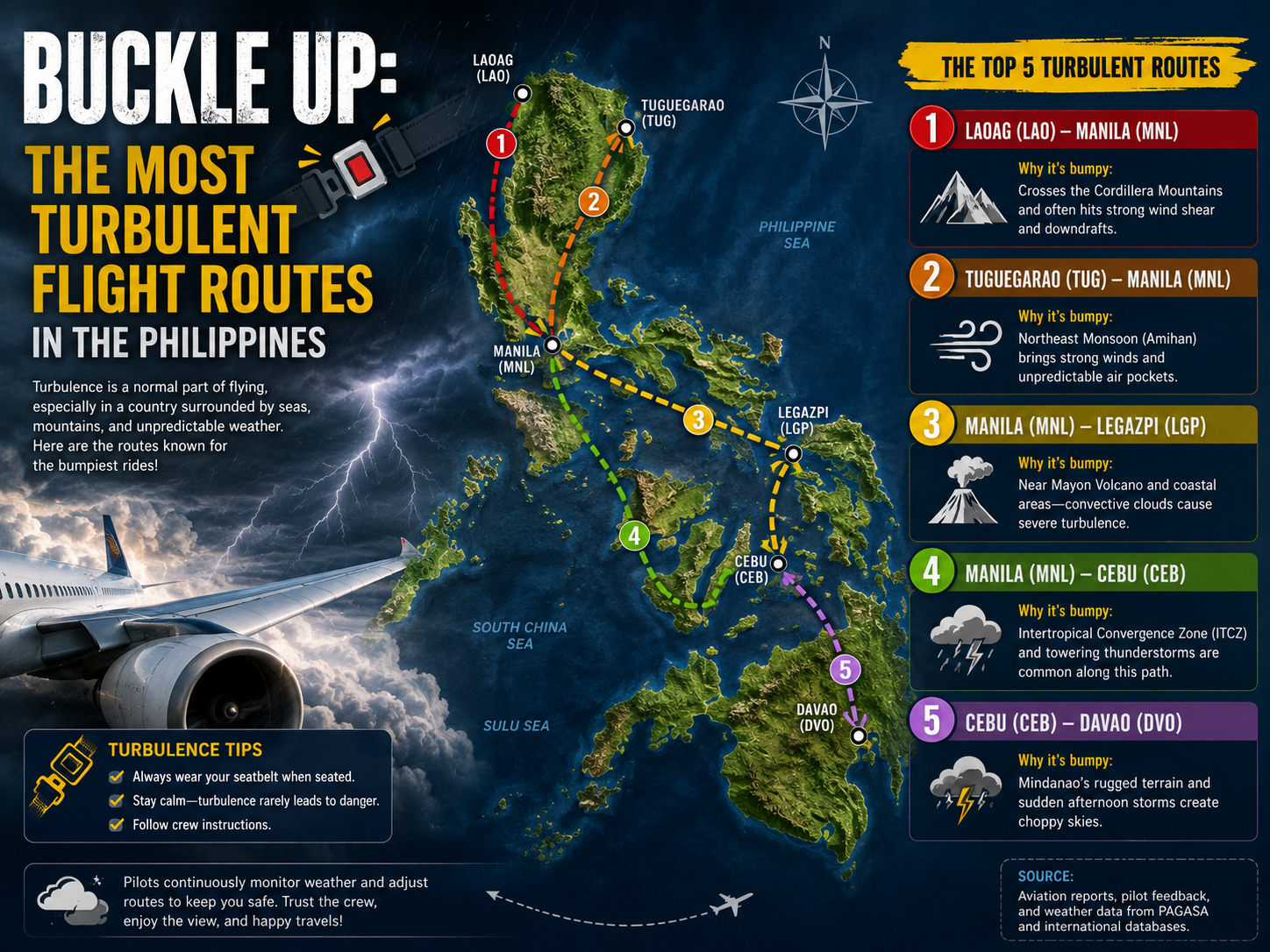
If you’ve ever felt your heart drop as the plane begins to rattle over the Philippine Sea, you aren’t alone. While the Philippines is famous for its “crystal clear” waters, the air above can sometimes be anything but smooth. A recent study by Turbli, an interactive turbulence forecast tool, has analyzed thousands of flight paths to identify where passengers are most likely to experience a bumpy ride.
In a country defined by 7,641 islands, mountainous terrain, and a tropical climate, turbulence is a natural part of the aviation landscape. Here is a breakdown of the most turbulent flight routes in the Philippines and why they keep pilots on their toes.
The Top Turbulent Routes in the Philippines
According to the latest data and historical EDR (Eddy Dissipation Rate) scores—the metric used to measure turbulence intensity—the following routes often rank as the “shakiest” in the archipelago:
| Route | Primary Cause | Typical Intensity |
| Manila (MNL) to Basco (BSO) | Convergence of Pacific winds and Batanes mountains. | Moderate to High |
| Manila (MNL) to Caticlan (MPH) | Coastal wind shear and low-altitude approach. | Light to Moderate |
| Cebu (CEB) to Siargao (IAO) | Open sea thermal currents and ITCZ activity. | Moderate |
| Manila (MNL) to Baguio (Loakan) | High-altitude mountain waves (The Cordillera Range). | Moderate to High |
1. Manila to Basco (Batanes): The “Everest” of Local Flights
Flying to Batanes is a bucket-list item for many, but it is notorious for being one of the most challenging routes. Situated at the northernmost tip of the country, Basco sits where the Pacific Ocean meets the South China Sea. The mix of high-speed winds and the rugged terrain of Mt. Iraya creates significant mechanical turbulence, making for some very “exciting” landings.
2. Manila to Caticlan: The Boracay Bump
While the flight is short, the approach into Caticlan (Boracay) often involves flying through coastal wind shears. Because the aircraft must descend over the coastline at lower altitudes, the transition between sea air and land air can cause those sudden, stomach-churning dips.
3. Trans-Visayas Routes (Cebu to Siargao/Sayak)
Routes over the Visayas often cross the Intertropical Convergence Zone (ITCZ). This is a region where winds from the northern and southern hemispheres meet, creating a belt of thunderstorms and “updrafts.” Passengers flying into Siargao often report “popcorn turbulence”—short, sharp bumps caused by the intense tropical heat rising from the ocean.
Why is the Philippines so Bumpy?
There are three main scientific reasons why Philippine skies are more active than others:
- Tropical Thunderstorms: The Philippines is in a “convective” zone. Heat causes air to rise rapidly, forming massive cumulonimbus clouds that act like speed bumps for airplanes.
- Mountain Waves: Range like the Sierra Madre and the Cordilleras disrupt smooth airflow, creating “waves” in the atmosphere that can shake a plane even in clear weather.
- The Jet Stream: While less frequent than in temperate zones, seasonal shifts in high-altitude winds can create Clear Air Turbulence (CAT), which is invisible to radar.
Tips for the Fearful Flyer
If these routes are on your itinerary, don’t panic. Modern aircraft are engineered to withstand forces far greater than any turbulence can provide.
- Sit over the wing: This is the plane’s center of gravity; you’ll feel the bumps much less here than in the tail.
- Keep your seatbelt fastened: Most turbulence-related injuries happen to passengers who aren’t buckled in during unexpected jolts.
- Fly in the morning: Thermal turbulence is usually at its lowest before the sun has a chance to heat up the ground and sea.
Are you planning a trip to one of these destinations soon?
Klook.com