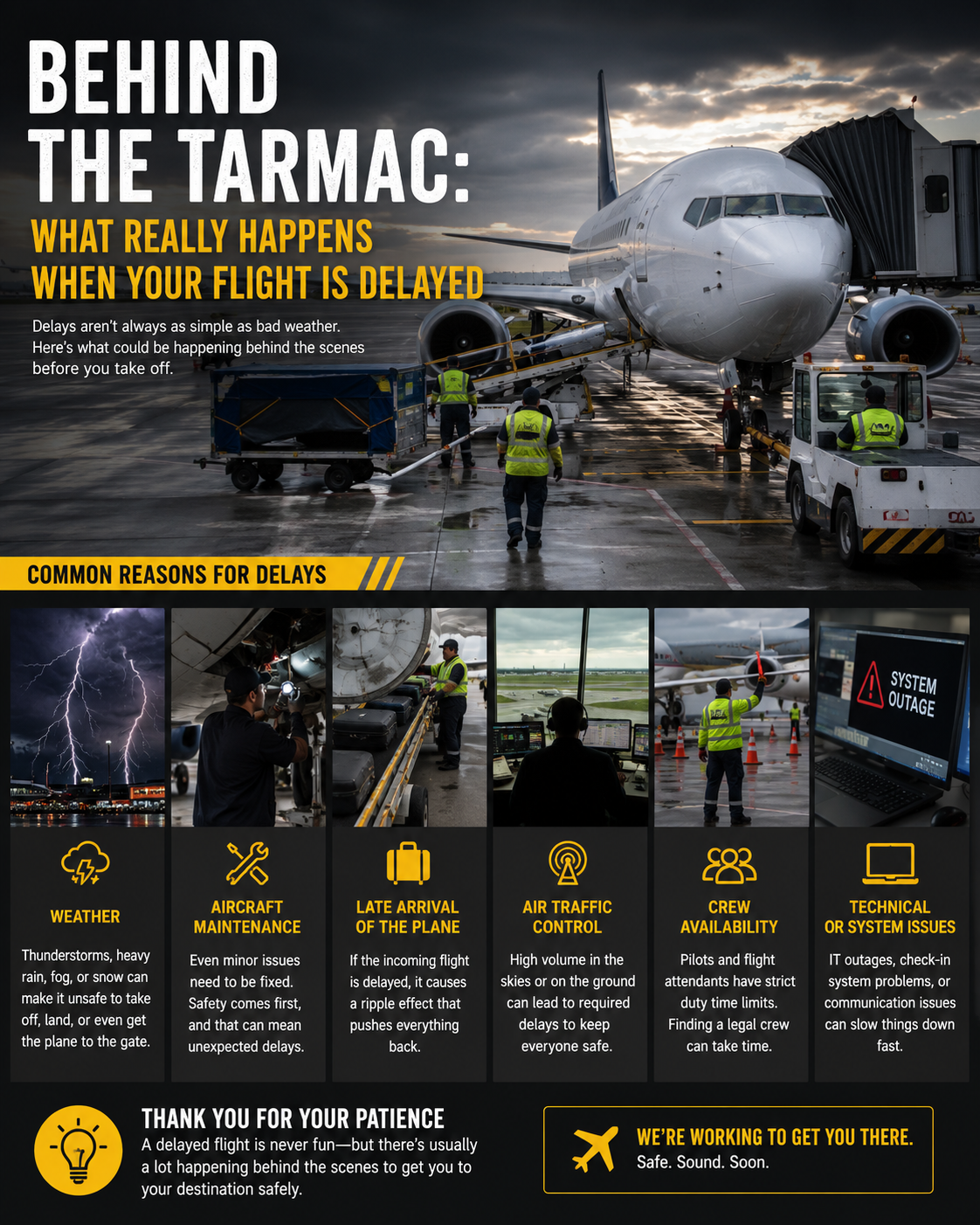
Behind the Tarmac: What Really Happens When Your Flight is Delayed
We’ve all been there: settled into a terminal seat with a coffee, only to hear the chime of the intercom followed by those dreaded words: “We regret to inform you…”
While it feels like a personal affront from the universe, a flight delay is actually the result of a massive, high-stakes logistical puzzle moving behind the scenes. From the cockpit to the control tower, hundreds of people are working to get you moving again.
Here is a look at the invisible machinery of an airline delay.
1. The Domino Effect of “Flow Control”
Airspace isn’t an infinite void; it’s a series of structured “highways.” When weather hits or a runway closes, Air Traffic Control (ATC) implements Ground Delay Programs.
Think of it like a digital funnel. If a hub airport can usually handle 60 landings an hour but a storm reduces that to 30, ATC “holds” planes at their departure gates across the country. Your plane might be perfectly fine, and the weather at your current airport might be sunny, but because your “slot” at the destination is gone, you stay put.
2. The Crew “Timing Out”
This is often the most frustrating reason for passengers because it feels avoidable. However, aviation safety is built on strict Duty Time Regulations.
Pilots and flight attendants have legal limits on how many hours they can work in a 24-hour period. If a previous delay pushes a crew over that limit, they are legally “illegal” to fly. Behind the scenes, the airline’s Crew Scheduling department is frantically searching for “reserve” crews. If no locals are available, they may even have to fly a crew in from another city just to operate your flight.
3. The “MEL” and Maintenance Math
When a mechanical issue arises, it’s rarely a surprise to the pilots. Most aircraft operate with a Minimum Equipment List (MEL). This is a manual that dictates which non-critical systems can be broken while still allowing the plane to fly safely (e.g., one of three reading lights in a row).
If a “No-Go” item breaks—something essential for safety—the plane is grounded. At this point:
- Maintenance Control coordinates with on-site mechanics.
- If a part isn’t in stock, it’s “AOG” (Aircraft on Ground) status, triggering an emergency shipment of the part via another flight.
- Technicians must perform the fix and sign off on rigorous documentation before the captain can accept the aircraft.
4. Weight, Balance, and Fueling
If the delay is due to weather, the “behind the scenes” team is likely recalculating the flight’s Weight and Balance.
If a plane needs to take a longer route to skirt a storm, it needs more fuel. More fuel means more weight. If the plane is too heavy, the “Load Desk” might have to remove cargo or—in extreme cases—bump passengers to ensure the plane can safely climb. These calculations are happening in real-time between the pilots and dispatchers in a central operations center.
Final Thoughts
A delay isn’t just a pause; it’s a recalibration of safety. While the lack of information at the gate can be exhausting, rest assured that in the “Ops Center,” specialists are playing a high-speed game of chess to get you to your destination safely.
Klook.com